Read page 2 as text
NorthStar Implant Dentistry, P.C. | Informed Consent for Oral Surgery | Rev. 09/2026
Page 2 of 4
© 2026 NorthStar Implant Dentistry, P.C. All rights reserved. Confidential and proprietary intellectual property; reproduction, distribution or use outside the practice requires express written permission.
INFORMED CONSENT FOR ORAL SURGERY
Patient: ______________________________
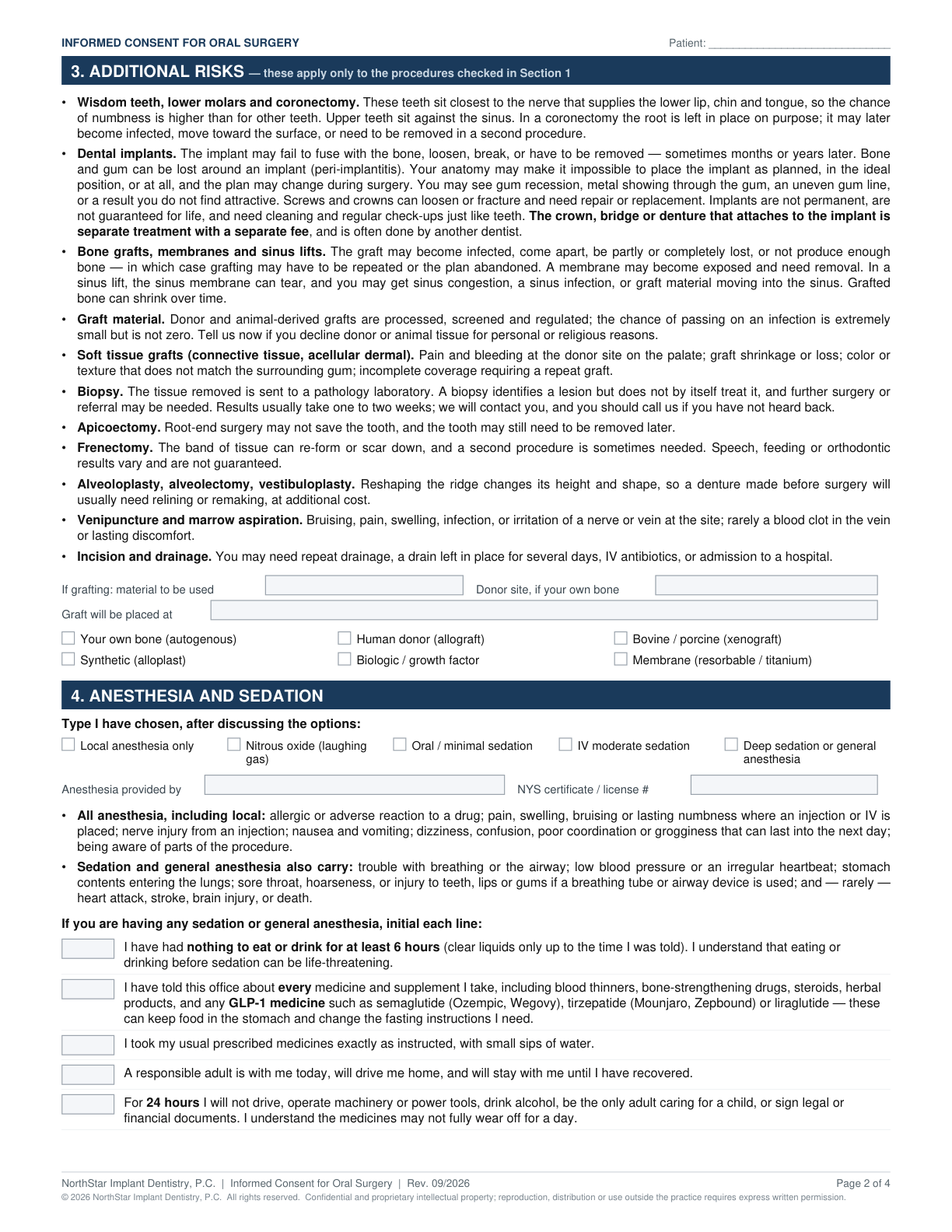
3. ADDITIONAL RISKS — these apply only to the procedures checked in Section 1
•
Wisdom teeth, lower molars and coronectomy. These teeth sit closest to the nerve that supplies the lower lip, chin and tongue, so the chance
of numbness is higher than for other teeth. Upper teeth sit against the sinus. In a coronectomy the root is left in place on purpose; it may later
become infected, move toward the surface, or need to be removed in a second procedure.
•
Dental implants. The implant may fail to fuse with the bone, loosen, break, or have to be removed — sometimes months or years later. Bone
and gum can be lost around an implant (peri-implantitis). Your anatomy may make it impossible to place the implant as planned, in the ideal
position, or at all, and the plan may change during surgery. You may see gum recession, metal showing through the gum, an uneven gum line,
or a result you do not find attractive. Screws and crowns can loosen or fracture and need repair or replacement. Implants are not permanent, are
not guaranteed for life, and need cleaning and regular check-ups just like teeth. The crown, bridge or denture that attaches to the implant is
separate treatment with a separate fee, and is often done by another dentist.
•
Bone grafts, membranes and sinus lifts. The graft may become infected, come apart, be partly or completely lost, or not produce enough
bone — in which case grafting may have to be repeated or the plan abandoned. A membrane may become exposed and need removal. In a
sinus lift, the sinus membrane can tear, and you may get sinus congestion, a sinus infection, or graft material moving into the sinus. Grafted
bone can shrink over time.
•
Graft material. Donor and animal-derived grafts are processed, screened and regulated; the chance of passing on an infection is extremely
small but is not zero. Tell us now if you decline donor or animal tissue for personal or religious reasons.
•
Soft tissue grafts (connective tissue, acellular dermal). Pain and bleeding at the donor site on the palate; graft shrinkage or loss; color or
texture that does not match the surrounding gum; incomplete coverage requiring a repeat graft.
•
Biopsy. The tissue removed is sent to a pathology laboratory. A biopsy identifies a lesion but does not by itself treat it, and further surgery or
referral may be needed. Results usually take one to two weeks; we will contact you, and you should call us if you have not heard back.
•
Apicoectomy. Root-end surgery may not save the tooth, and the tooth may still need to be removed later.
•
Frenectomy. The band of tissue can re-form or scar down, and a second procedure is sometimes needed. Speech, feeding or orthodontic
results vary and are not guaranteed.
•
Alveoloplasty, alveolectomy, vestibuloplasty. Reshaping the ridge changes its height and shape, so a denture made before surgery will
usually need relining or remaking, at additional cost.
•
Venipuncture and marrow aspiration. Bruising, pain, swelling, infection, or irritation of a nerve or vein at the site; rarely a blood clot in the vein
or lasting discomfort.
•
Incision and drainage. You may need repeat drainage, a drain left in place for several days, IV antibiotics, or admission to a hospital.
If grafting: material to be used
Donor site, if your own bone
Graft will be placed at
Your own bone (autogenous)
Human donor (allograft)
Bovine / porcine (xenograft)
Synthetic (alloplast)
Biologic / growth factor
Membrane (resorbable / titanium)
4. ANESTHESIA AND SEDATION
Type I have chosen, after discussing the options:
Local anesthesia only
Nitrous oxide (laughing
gas)
Oral / minimal sedation
IV moderate sedation
Deep sedation or general
anesthesia
Anesthesia provided by
NYS certificate / license #
•
All anesthesia, including local: allergic or adverse reaction to a drug; pain, swelling, bruising or lasting numbness where an injection or IV is
placed; nerve injury from an injection; nausea and vomiting; dizziness, confusion, poor coordination or grogginess that can last into the next day;
being aware of parts of the procedure.
•
Sedation and general anesthesia also carry: trouble with breathing or the airway; low blood pressure or an irregular heartbeat; stomach
contents entering the lungs; sore throat, hoarseness, or injury to teeth, lips or gums if a breathing tube or airway device is used; and — rarely —
heart attack, stroke, brain injury, or death.
If you are having any sedation or general anesthesia, initial each line:
I have had nothing to eat or drink for at least 6 hours (clear liquids only up to the time I was told). I understand that eating or
drinking before sedation can be life-threatening.
I have told this office about every medicine and supplement I take, including blood thinners, bone-strengthening drugs, steroids, herbal
products, and any GLP-1 medicine such as semaglutide (Ozempic, Wegovy), tirzepatide (Mounjaro, Zepbound) or liraglutide — these
can keep food in the stomach and change the fasting instructions I need.
I took my usual prescribed medicines exactly as instructed, with small sips of water.
A responsible adult is with me today, will drive me home, and will stay with me until I have recovered.
For 24 hours I will not drive, operate machinery or power tools, drink alcohol, be the only adult caring for a child, or sign legal or
financial documents. I understand the medicines may not fully wear off for a day.