📍 Briarwood · New York · Commack·📞 631-315-1400·Mon–Sat 9am–8pm · Sunday by appointment
Dr. Peter Kampf & Associates
  • About
  • Procedures
  • Dental Implants
  • Full-Arch
  • Wisdom Teeth
  • Sedation
  • Patient Info
  • Technology
  • Testimonials
  • Contact
  • Locations
AboutProceduresDental ImplantsFull-ArchWisdom TeethSedationPatient InfoTechnologyTestimonialsContactLocations📞 631-315-1400
← Back to Home/Patient-Specific / Subperiosteal Implant

Patient consent forms

Patient-Specific / Subperiosteal Implant

Review your consent form and prepare a copy for your visit.

Book a Consultation

Review, complete, and bring to your visit

This is the full 5-page form supplied by our practice. Fill in the appropriate fields below. Leave treatment details you are unsure about and office-use fields for your clinician. Initial only statements you understand and have discussed. Signatures should be completed after your questions have been answered; signature lines remain blank in this online preparation version.

Your entries are not submitted or stored by this form. Leaving or refreshing clears them. Print or save a copy on a device you trust, and bring it to your appointment. Do not send completed forms through the general contact form.

On a small screen, scroll sideways to see the complete page. For more convenient editing, download the fillable PDF and open it in a PDF reader.

Download Fillable PDF · 5 pagesBack to Patient Forms

Page 1 of 5

Read page 1 as text
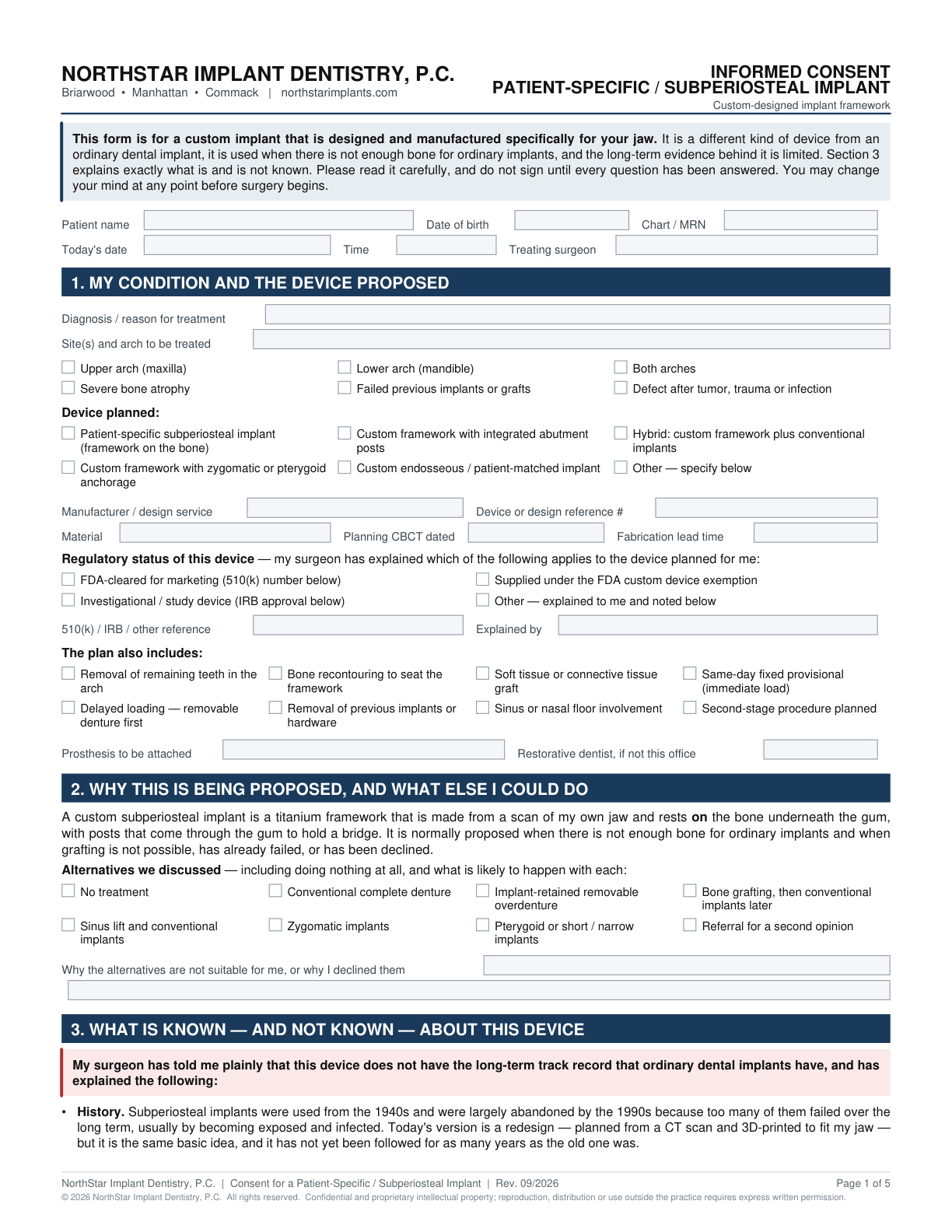
NorthStar Implant Dentistry, P.C. | Consent for a Patient-Specific / Subperiosteal Implant | Rev. 09/2026 Page 1 of 5 © 2026 NorthStar Implant Dentistry, P.C. All rights reserved. Confidential and proprietary intellectual property; reproduction, distribution or use outside the practice requires express written permission. NORTHSTAR IMPLANT DENTISTRY, P.C. Briarwood • Manhattan • Commack | northstarimplants.com INFORMED CONSENT PATIENT-SPECIFIC / SUBPERIOSTEAL IMPLANT Custom-designed implant framework This form is for a custom implant that is designed and manufactured specifically for your jaw. It is a different kind of device from an ordinary dental implant, it is used when there is not enough bone for ordinary implants, and the long-term evidence behind it is limited. Section 3 explains exactly what is and is not known. Please read it carefully, and do not sign until every question has been answered. You may change your mind at any point before surgery begins. Patient name Date of birth Chart / MRN Today's date Time Treating surgeon 1. MY CONDITION AND THE DEVICE PROPOSED Diagnosis / reason for treatment Site(s) and arch to be treated Upper arch (maxilla) Lower arch (mandible) Both arches Severe bone atrophy Failed previous implants or grafts Defect after tumor, trauma or infection Device planned: Patient-specific subperiosteal implant (framework on the bone) Custom framework with integrated abutment posts Hybrid: custom framework plus conventional implants Custom framework with zygomatic or pterygoid anchorage Custom endosseous / patient-matched implant Other — specify below Manufacturer / design service Device or design reference # Material Planning CBCT dated Fabrication lead time Regulatory status of this device — my surgeon has explained which of the following applies to the device planned for me: FDA-cleared for marketing (510(k) number below) Supplied under the FDA custom device exemption Investigational / study device (IRB approval below) Other — explained to me and noted below 510(k) / IRB / other reference Explained by The plan also includes: Removal of remaining teeth in the arch Bone recontouring to seat the framework Soft tissue or connective tissue graft Same-day fixed provisional (immediate load) Delayed loading — removable denture first Removal of previous implants or hardware Sinus or nasal floor involvement Second-stage procedure planned Prosthesis to be attached Restorative dentist, if not this office 2. WHY THIS IS BEING PROPOSED, AND WHAT ELSE I COULD DO A custom subperiosteal implant is a titanium framework that is made from a scan of my own jaw and rests on the bone underneath the gum, with posts that come through the gum to hold a bridge. It is normally proposed when there is not enough bone for ordinary implants and when grafting is not possible, has already failed, or has been declined. Alternatives we discussed — including doing nothing at all, and what is likely to happen with each: No treatment Conventional complete denture Implant-retained removable overdenture Bone grafting, then conventional implants later Sinus lift and conventional implants Zygomatic implants Pterygoid or short / narrow implants Referral for a second opinion Why the alternatives are not suitable for me, or why I declined them 3. WHAT IS KNOWN — AND NOT KNOWN — ABOUT THIS DEVICE My surgeon has told me plainly that this device does not have the long-term track record that ordinary dental implants have, and has explained the following: • History. Subperiosteal implants were used from the 1940s and were largely abandoned by the 1990s because too many of them failed over the long term, usually by becoming exposed and infected. Today's version is a redesign — planned from a CT scan and 3D-printed to fit my jaw — but it is the same basic idea, and it has not yet been followed for as many years as the old one was.
Original form page 1; full text is available above

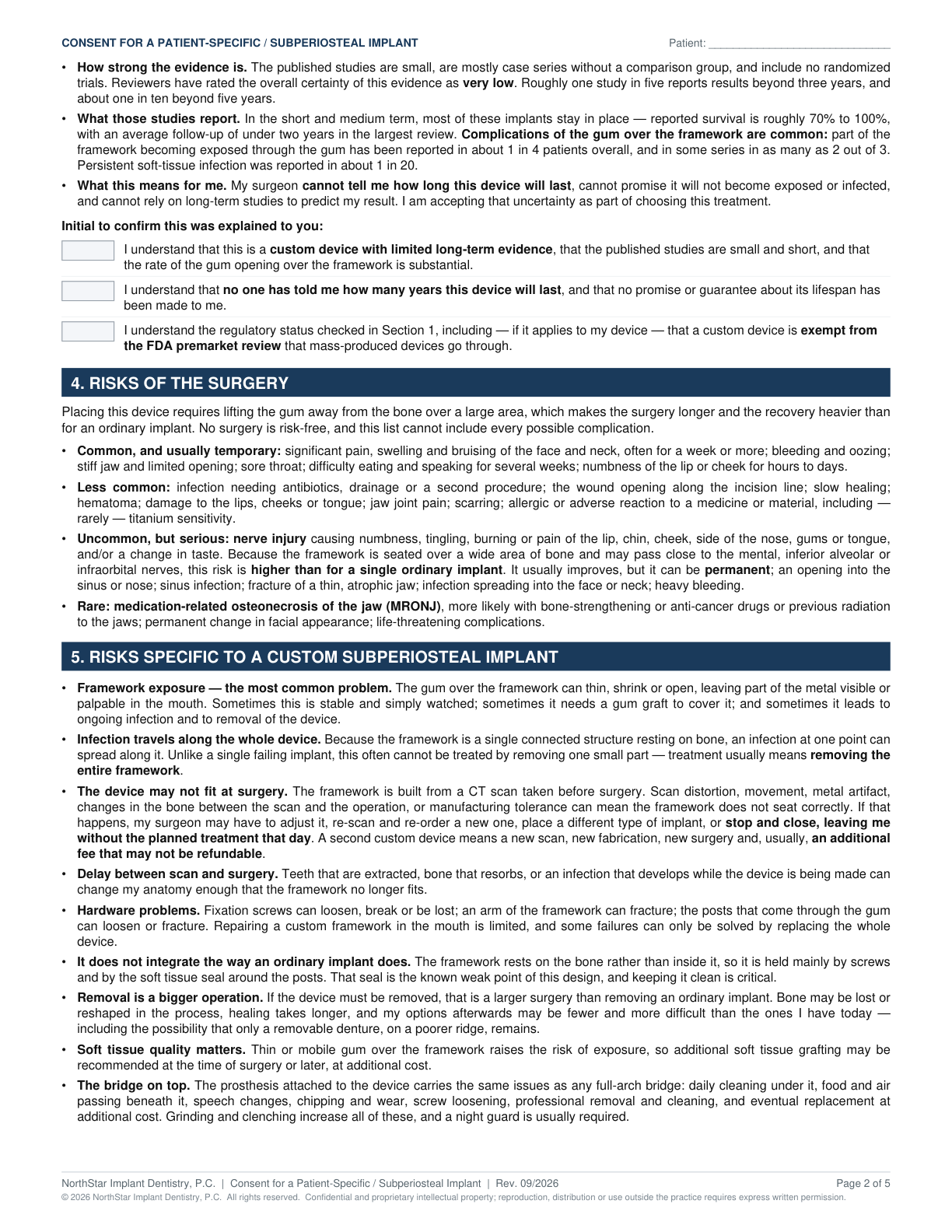
Page 2 of 5

Read page 2 as text
NorthStar Implant Dentistry, P.C. | Consent for a Patient-Specific / Subperiosteal Implant | Rev. 09/2026 Page 2 of 5 © 2026 NorthStar Implant Dentistry, P.C. All rights reserved. Confidential and proprietary intellectual property; reproduction, distribution or use outside the practice requires express written permission. CONSENT FOR A PATIENT-SPECIFIC / SUBPERIOSTEAL IMPLANT Patient: ______________________________ • How strong the evidence is. The published studies are small, are mostly case series without a comparison group, and include no randomized trials. Reviewers have rated the overall certainty of this evidence as very low. Roughly one study in five reports results beyond three years, and about one in ten beyond five years. • What those studies report. In the short and medium term, most of these implants stay in place — reported survival is roughly 70% to 100%, with an average follow-up of under two years in the largest review. Complications of the gum over the framework are common: part of the framework becoming exposed through the gum has been reported in about 1 in 4 patients overall, and in some series in as many as 2 out of 3. Persistent soft-tissue infection was reported in about 1 in 20. • What this means for me. My surgeon cannot tell me how long this device will last, cannot promise it will not become exposed or infected, and cannot rely on long-term studies to predict my result. I am accepting that uncertainty as part of choosing this treatment. Initial to confirm this was explained to you: I understand that this is a custom device with limited long-term evidence, that the published studies are small and short, and that the rate of the gum opening over the framework is substantial. I understand that no one has told me how many years this device will last, and that no promise or guarantee about its lifespan has been made to me. I understand the regulatory status checked in Section 1, including — if it applies to my device — that a custom device is exempt from the FDA premarket review that mass-produced devices go through. 4. RISKS OF THE SURGERY Placing this device requires lifting the gum away from the bone over a large area, which makes the surgery longer and the recovery heavier than for an ordinary implant. No surgery is risk-free, and this list cannot include every possible complication. • Common, and usually temporary: significant pain, swelling and bruising of the face and neck, often for a week or more; bleeding and oozing; stiff jaw and limited opening; sore throat; difficulty eating and speaking for several weeks; numbness of the lip or cheek for hours to days. • Less common: infection needing antibiotics, drainage or a second procedure; the wound opening along the incision line; slow healing; hematoma; damage to the lips, cheeks or tongue; jaw joint pain; scarring; allergic or adverse reaction to a medicine or material, including — rarely — titanium sensitivity. • Uncommon, but serious: nerve injury causing numbness, tingling, burning or pain of the lip, chin, cheek, side of the nose, gums or tongue, and/or a change in taste. Because the framework is seated over a wide area of bone and may pass close to the mental, inferior alveolar or infraorbital nerves, this risk is higher than for a single ordinary implant. It usually improves, but it can be permanent; an opening into the sinus or nose; sinus infection; fracture of a thin, atrophic jaw; infection spreading into the face or neck; heavy bleeding. • Rare: medication-related osteonecrosis of the jaw (MRONJ), more likely with bone-strengthening or anti-cancer drugs or previous radiation to the jaws; permanent change in facial appearance; life-threatening complications. 5. RISKS SPECIFIC TO A CUSTOM SUBPERIOSTEAL IMPLANT • Framework exposure — the most common problem. The gum over the framework can thin, shrink or open, leaving part of the metal visible or palpable in the mouth. Sometimes this is stable and simply watched; sometimes it needs a gum graft to cover it; and sometimes it leads to ongoing infection and to removal of the device. • Infection travels along the whole device. Because the framework is a single connected structure resting on bone, an infection at one point can spread along it. Unlike a single failing implant, this often cannot be treated by removing one small part — treatment usually means removing the entire framework. • The device may not fit at surgery. The framework is built from a CT scan taken before surgery. Scan distortion, movement, metal artifact, changes in the bone between the scan and the operation, or manufacturing tolerance can mean the framework does not seat correctly. If that happens, my surgeon may have to adjust it, re-scan and re-order a new one, place a different type of implant, or stop and close, leaving me without the planned treatment that day. A second custom device means a new scan, new fabrication, new surgery and, usually, an additional fee that may not be refundable. • Delay between scan and surgery. Teeth that are extracted, bone that resorbs, or an infection that develops while the device is being made can change my anatomy enough that the framework no longer fits. • Hardware problems. Fixation screws can loosen, break or be lost; an arm of the framework can fracture; the posts that come through the gum can loosen or fracture. Repairing a custom framework in the mouth is limited, and some failures can only be solved by replacing the whole device. • It does not integrate the way an ordinary implant does. The framework rests on the bone rather than inside it, so it is held mainly by screws and by the soft tissue seal around the posts. That seal is the known weak point of this design, and keeping it clean is critical. • Removal is a bigger operation. If the device must be removed, that is a larger surgery than removing an ordinary implant. Bone may be lost or reshaped in the process, healing takes longer, and my options afterwards may be fewer and more difficult than the ones I have today — including the possibility that only a removable denture, on a poorer ridge, remains. • Soft tissue quality matters. Thin or mobile gum over the framework raises the risk of exposure, so additional soft tissue grafting may be recommended at the time of surgery or later, at additional cost. • The bridge on top. The prosthesis attached to the device carries the same issues as any full-arch bridge: daily cleaning under it, food and air passing beneath it, speech changes, chipping and wear, screw loosening, professional removal and cleaning, and eventual replacement at additional cost. Grinding and clenching increase all of these, and a night guard is usually required.
Original form page 2; full text is available above

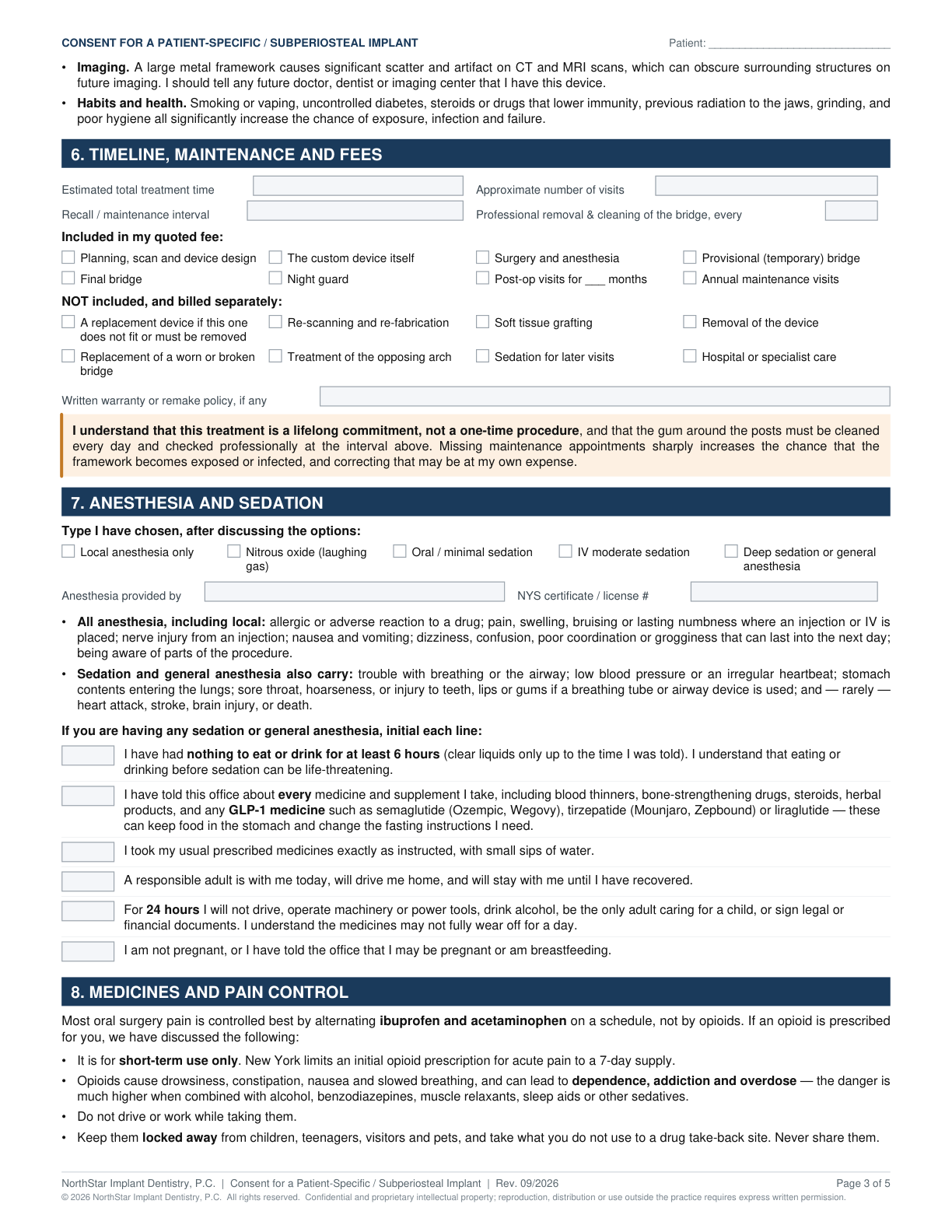
Page 3 of 5

Read page 3 as text
NorthStar Implant Dentistry, P.C. | Consent for a Patient-Specific / Subperiosteal Implant | Rev. 09/2026 Page 3 of 5 © 2026 NorthStar Implant Dentistry, P.C. All rights reserved. Confidential and proprietary intellectual property; reproduction, distribution or use outside the practice requires express written permission. CONSENT FOR A PATIENT-SPECIFIC / SUBPERIOSTEAL IMPLANT Patient: ______________________________ • Imaging. A large metal framework causes significant scatter and artifact on CT and MRI scans, which can obscure surrounding structures on future imaging. I should tell any future doctor, dentist or imaging center that I have this device. • Habits and health. Smoking or vaping, uncontrolled diabetes, steroids or drugs that lower immunity, previous radiation to the jaws, grinding, and poor hygiene all significantly increase the chance of exposure, infection and failure. 6. TIMELINE, MAINTENANCE AND FEES Estimated total treatment time Approximate number of visits Recall / maintenance interval Professional removal & cleaning of the bridge, every Included in my quoted fee: Planning, scan and device design The custom device itself Surgery and anesthesia Provisional (temporary) bridge Final bridge Night guard Post-op visits for ___ months Annual maintenance visits NOT included, and billed separately: A replacement device if this one does not fit or must be removed Re-scanning and re-fabrication Soft tissue grafting Removal of the device Replacement of a worn or broken bridge Treatment of the opposing arch Sedation for later visits Hospital or specialist care Written warranty or remake policy, if any I understand that this treatment is a lifelong commitment, not a one-time procedure, and that the gum around the posts must be cleaned every day and checked professionally at the interval above. Missing maintenance appointments sharply increases the chance that the framework becomes exposed or infected, and correcting that may be at my own expense. 7. ANESTHESIA AND SEDATION Type I have chosen, after discussing the options: Local anesthesia only Nitrous oxide (laughing gas) Oral / minimal sedation IV moderate sedation Deep sedation or general anesthesia Anesthesia provided by NYS certificate / license # • All anesthesia, including local: allergic or adverse reaction to a drug; pain, swelling, bruising or lasting numbness where an injection or IV is placed; nerve injury from an injection; nausea and vomiting; dizziness, confusion, poor coordination or grogginess that can last into the next day; being aware of parts of the procedure. • Sedation and general anesthesia also carry: trouble with breathing or the airway; low blood pressure or an irregular heartbeat; stomach contents entering the lungs; sore throat, hoarseness, or injury to teeth, lips or gums if a breathing tube or airway device is used; and — rarely — heart attack, stroke, brain injury, or death. If you are having any sedation or general anesthesia, initial each line: I have had nothing to eat or drink for at least 6 hours (clear liquids only up to the time I was told). I understand that eating or drinking before sedation can be life-threatening. I have told this office about every medicine and supplement I take, including blood thinners, bone-strengthening drugs, steroids, herbal products, and any GLP-1 medicine such as semaglutide (Ozempic, Wegovy), tirzepatide (Mounjaro, Zepbound) or liraglutide — these can keep food in the stomach and change the fasting instructions I need. I took my usual prescribed medicines exactly as instructed, with small sips of water. A responsible adult is with me today, will drive me home, and will stay with me until I have recovered. For 24 hours I will not drive, operate machinery or power tools, drink alcohol, be the only adult caring for a child, or sign legal or financial documents. I understand the medicines may not fully wear off for a day. I am not pregnant, or I have told the office that I may be pregnant or am breastfeeding. 8. MEDICINES AND PAIN CONTROL Most oral surgery pain is controlled best by alternating ibuprofen and acetaminophen on a schedule, not by opioids. If an opioid is prescribed for you, we have discussed the following: • It is for short-term use only. New York limits an initial opioid prescription for acute pain to a 7-day supply. • Opioids cause drowsiness, constipation, nausea and slowed breathing, and can lead to dependence, addiction and overdose — the danger is much higher when combined with alcohol, benzodiazepines, muscle relaxants, sleep aids or other sedatives. • Do not drive or work while taking them. • Keep them locked away from children, teenagers, visitors and pets, and take what you do not use to a drug take-back site. Never share them.
Original form page 3; full text is available above

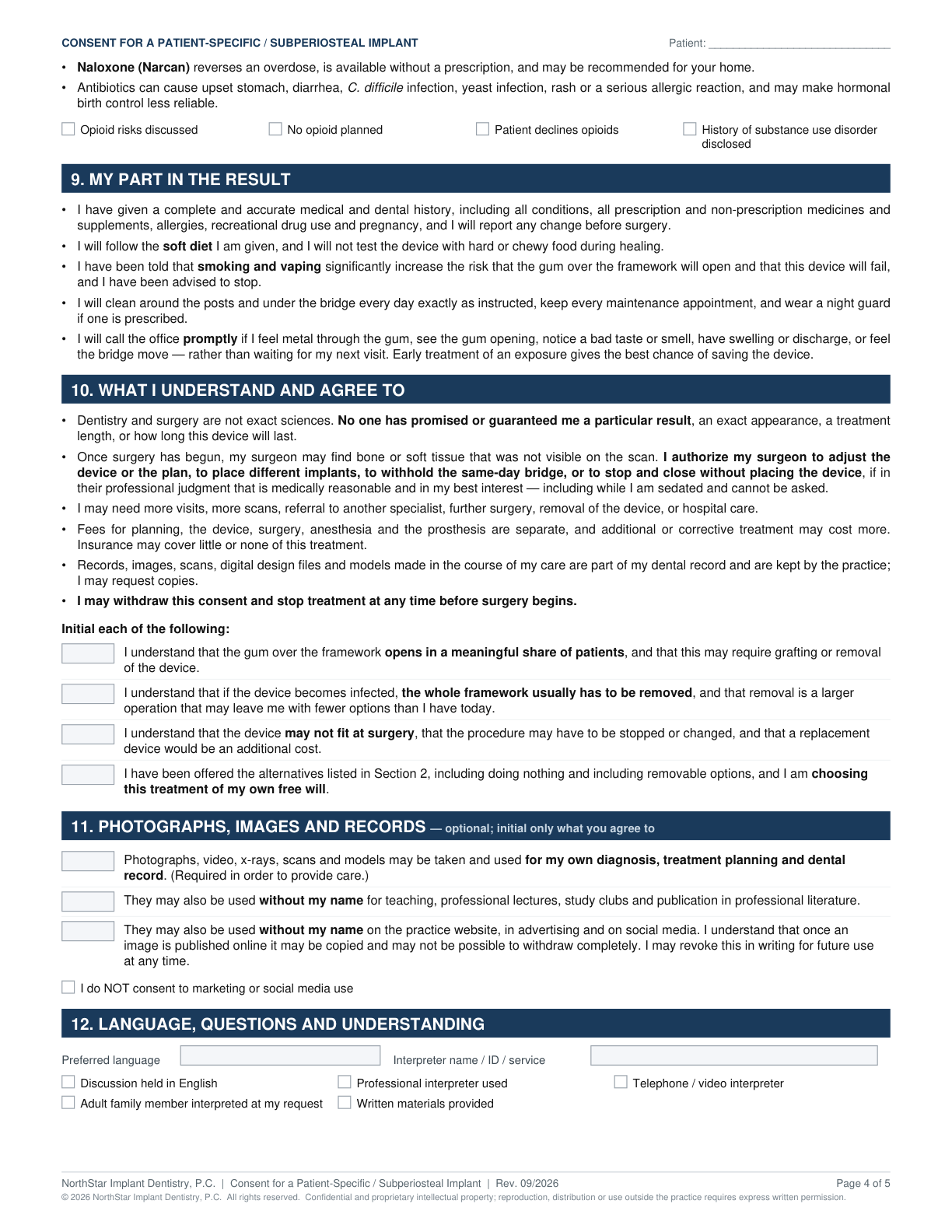
Page 4 of 5

Read page 4 as text
NorthStar Implant Dentistry, P.C. | Consent for a Patient-Specific / Subperiosteal Implant | Rev. 09/2026 Page 4 of 5 © 2026 NorthStar Implant Dentistry, P.C. All rights reserved. Confidential and proprietary intellectual property; reproduction, distribution or use outside the practice requires express written permission. CONSENT FOR A PATIENT-SPECIFIC / SUBPERIOSTEAL IMPLANT Patient: ______________________________ • Naloxone (Narcan) reverses an overdose, is available without a prescription, and may be recommended for your home. • Antibiotics can cause upset stomach, diarrhea, C. difficile infection, yeast infection, rash or a serious allergic reaction, and may make hormonal birth control less reliable. Opioid risks discussed No opioid planned Patient declines opioids History of substance use disorder disclosed 9. MY PART IN THE RESULT • I have given a complete and accurate medical and dental history, including all conditions, all prescription and non-prescription medicines and supplements, allergies, recreational drug use and pregnancy, and I will report any change before surgery. • I will follow the soft diet I am given, and I will not test the device with hard or chewy food during healing. • I have been told that smoking and vaping significantly increase the risk that the gum over the framework will open and that this device will fail, and I have been advised to stop. • I will clean around the posts and under the bridge every day exactly as instructed, keep every maintenance appointment, and wear a night guard if one is prescribed. • I will call the office promptly if I feel metal through the gum, see the gum opening, notice a bad taste or smell, have swelling or discharge, or feel the bridge move — rather than waiting for my next visit. Early treatment of an exposure gives the best chance of saving the device. 10. WHAT I UNDERSTAND AND AGREE TO • Dentistry and surgery are not exact sciences. No one has promised or guaranteed me a particular result, an exact appearance, a treatment length, or how long this device will last. • Once surgery has begun, my surgeon may find bone or soft tissue that was not visible on the scan. I authorize my surgeon to adjust the device or the plan, to place different implants, to withhold the same-day bridge, or to stop and close without placing the device, if in their professional judgment that is medically reasonable and in my best interest — including while I am sedated and cannot be asked. • I may need more visits, more scans, referral to another specialist, further surgery, removal of the device, or hospital care. • Fees for planning, the device, surgery, anesthesia and the prosthesis are separate, and additional or corrective treatment may cost more. Insurance may cover little or none of this treatment. • Records, images, scans, digital design files and models made in the course of my care are part of my dental record and are kept by the practice; I may request copies. • I may withdraw this consent and stop treatment at any time before surgery begins. Initial each of the following: I understand that the gum over the framework opens in a meaningful share of patients, and that this may require grafting or removal of the device. I understand that if the device becomes infected, the whole framework usually has to be removed, and that removal is a larger operation that may leave me with fewer options than I have today. I understand that the device may not fit at surgery, that the procedure may have to be stopped or changed, and that a replacement device would be an additional cost. I have been offered the alternatives listed in Section 2, including doing nothing and including removable options, and I am choosing this treatment of my own free will. 11. PHOTOGRAPHS, IMAGES AND RECORDS — optional; initial only what you agree to Photographs, video, x-rays, scans and models may be taken and used for my own diagnosis, treatment planning and dental record. (Required in order to provide care.) They may also be used without my name for teaching, professional lectures, study clubs and publication in professional literature. They may also be used without my name on the practice website, in advertising and on social media. I understand that once an image is published online it may be copied and may not be possible to withdraw completely. I may revoke this in writing for future use at any time. I do NOT consent to marketing or social media use 12. LANGUAGE, QUESTIONS AND UNDERSTANDING Preferred language Interpreter name / ID / service Discussion held in English Professional interpreter used Telephone / video interpreter Adult family member interpreted at my request Written materials provided
Original form page 4; full text is available above

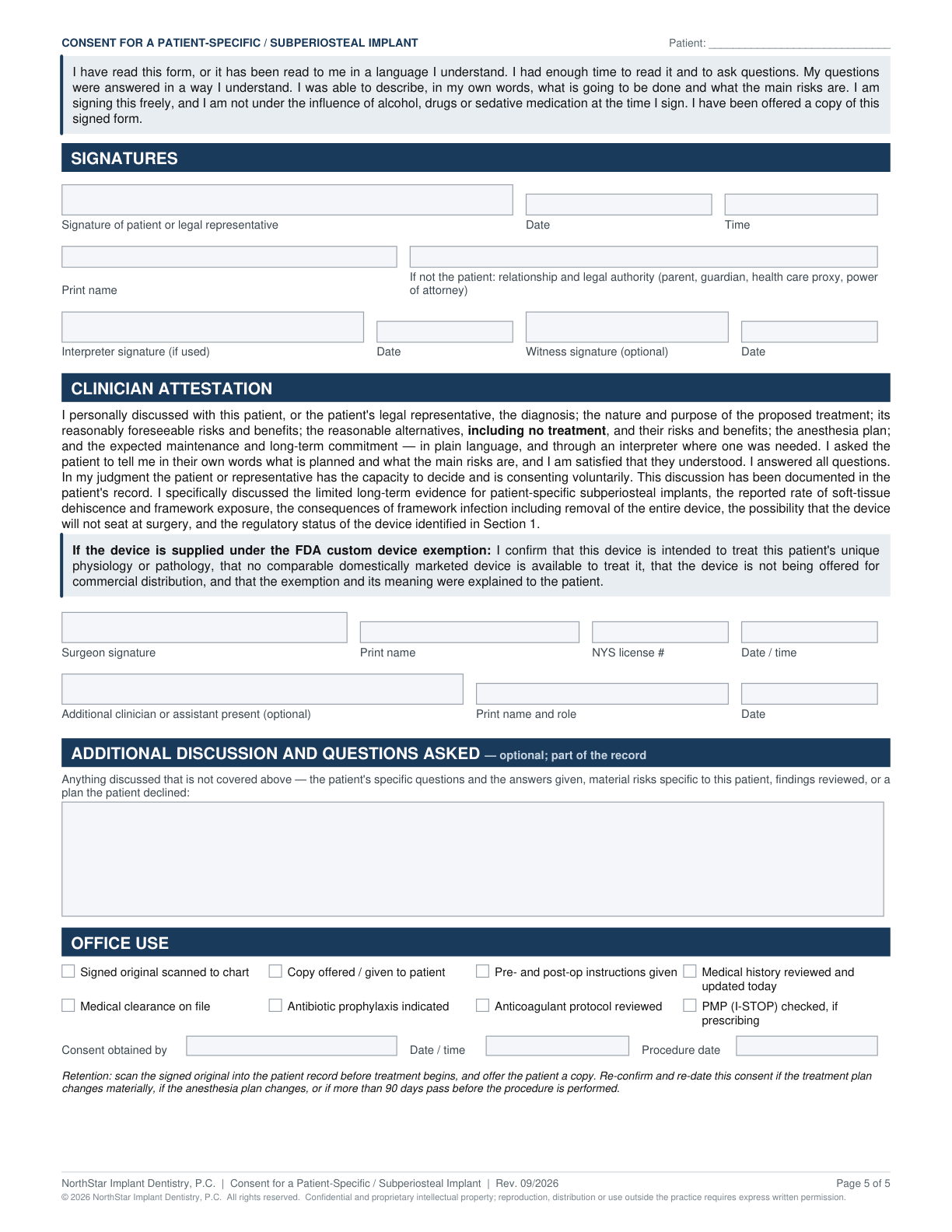
Page 5 of 5

Read page 5 as text
NorthStar Implant Dentistry, P.C. | Consent for a Patient-Specific / Subperiosteal Implant | Rev. 09/2026 Page 5 of 5 © 2026 NorthStar Implant Dentistry, P.C. All rights reserved. Confidential and proprietary intellectual property; reproduction, distribution or use outside the practice requires express written permission. CONSENT FOR A PATIENT-SPECIFIC / SUBPERIOSTEAL IMPLANT Patient: ______________________________ I have read this form, or it has been read to me in a language I understand. I had enough time to read it and to ask questions. My questions were answered in a way I understand. I was able to describe, in my own words, what is going to be done and what the main risks are. I am signing this freely, and I am not under the influence of alcohol, drugs or sedative medication at the time I sign. I have been offered a copy of this signed form. SIGNATURES Signature of patient or legal representative Date Time Print name If not the patient: relationship and legal authority (parent, guardian, health care proxy, power of attorney) Interpreter signature (if used) Date Witness signature (optional) Date CLINICIAN ATTESTATION I personally discussed with this patient, or the patient's legal representative, the diagnosis; the nature and purpose of the proposed treatment; its reasonably foreseeable risks and benefits; the reasonable alternatives, including no treatment, and their risks and benefits; the anesthesia plan; and the expected maintenance and long-term commitment — in plain language, and through an interpreter where one was needed. I asked the patient to tell me in their own words what is planned and what the main risks are, and I am satisfied that they understood. I answered all questions. In my judgment the patient or representative has the capacity to decide and is consenting voluntarily. This discussion has been documented in the patient's record. I specifically discussed the limited long-term evidence for patient-specific subperiosteal implants, the reported rate of soft-tissue dehiscence and framework exposure, the consequences of framework infection including removal of the entire device, the possibility that the device will not seat at surgery, and the regulatory status of the device identified in Section 1. If the device is supplied under the FDA custom device exemption: I confirm that this device is intended to treat this patient's unique physiology or pathology, that no comparable domestically marketed device is available to treat it, that the device is not being offered for commercial distribution, and that the exemption and its meaning were explained to the patient. Surgeon signature Print name NYS license # Date / time Additional clinician or assistant present (optional) Print name and role Date ADDITIONAL DISCUSSION AND QUESTIONS ASKED — optional; part of the record Anything discussed that is not covered above — the patient's specific questions and the answers given, material risks specific to this patient, findings reviewed, or a plan the patient declined: OFFICE USE Signed original scanned to chart Copy offered / given to patient Pre- and post-op instructions given Medical history reviewed and updated today Medical clearance on file Antibiotic prophylaxis indicated Anticoagulant protocol reviewed PMP (I-STOP) checked, if prescribing Consent obtained by Date / time Procedure date Retention: scan the signed original into the patient record before treatment begins, and offer the patient a copy. Re-confirm and re-date this consent if the treatment plan changes materially, if the anesthesia plan changes, or if more than 90 days pass before the procedure is performed.
Original form page 5; full text is available above

NorthStar Implant Dentistry  ·  Briarwood · New York · Commack  ·  631-315-1400

© 2026 NorthStar Implant Dentistry, P.C. All rights reserved. NorthStar Implant Dentistry™, the NorthStar compass wheel design, and “Guiding Patients One Smile at a Time”™ are trademarks of NorthStar Implant Dentistry, P.C.

← Return to Homepage·Terms of Use